Checks
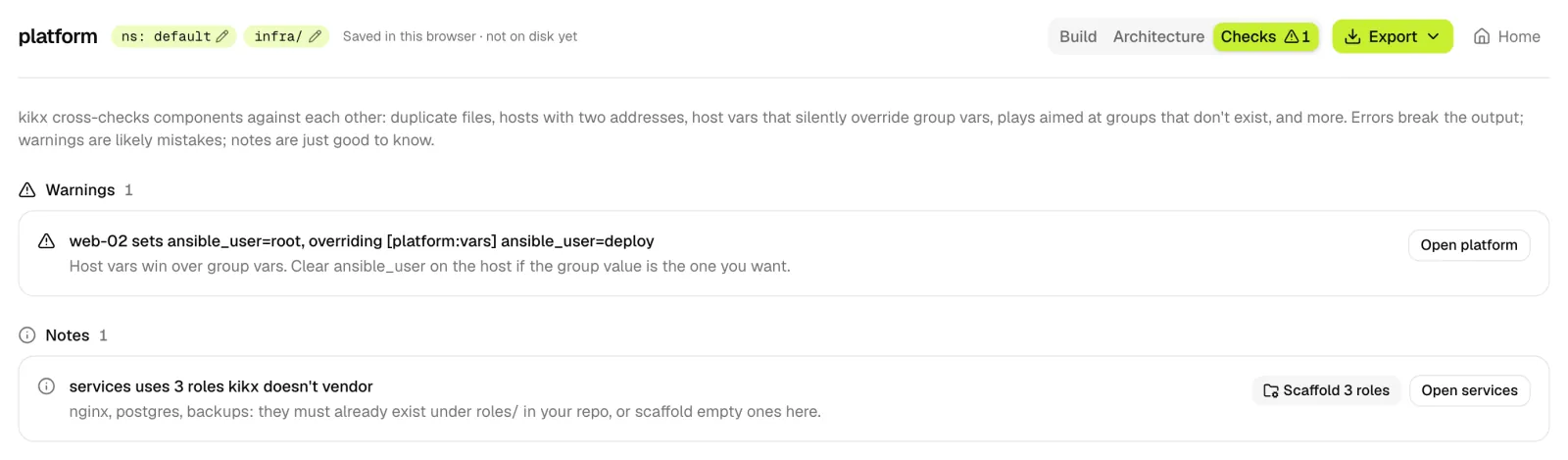
The dashboard’s Checks view, computed in the browser by checkProject in web/lib/project/checks.ts. Checks read component field values; they do not call the backend or read files on disk.
Severities
Severity |
Order |
|---|
error
|
1 |
warning
|
2 |
info
|
3 |
Issues are listed in this order.
Summary
In ID patterns, <inventory>, <group-vars>, <playbook>, <site>, <service>, <ingress>, <component> and <other component> are the dashboard’s internal component IDs.
Definitions
Term |
Meaning |
|---|
Inventory entries |
The parsed hosts field of an ansible/inventory component. See Components |
Known groups |
all, ungrouped, and every group and children name in every inventory
|
Addressed hosts |
Host names that have an ansible_host in any inventory |
Normalised address |
An ansible_host that is an IPv4 or IPv6 address, in canonical form (IPv6 compressed and lowercase); any other value lowercased |
Range fields |
Non-empty fields whose registry format is cidr and whose value is a valid range |
Group of a group-vars component |
Its group field, else its component name |
Plays |
The parsed plays field of an ansible/playbook component, else one play from its hosts and roles fields |
Play targets |
The play’s hosts split on : and ,, trimmed, with a leading ! or & removed, empty parts dropped |
Playbook path |
<folder>/<name>.yml with trailing / removed from folder, or <name>.yml when folder is empty
|
Vendored roles |
Names of ansible/* components, other than inventory, group-vars, playbook and site, that render more than one file |
App label |
A component’s app label, else its name |
Checks that compare against the inventory (gv-group, play-hosts) run only when the project has at least one inventory.
dup-file
|
|
|---|
Severity |
error
|
Trigger |
Two or more components render a file with the same path |
Title |
<count> components write <file>
|
Detail |
Only the last one survives in the download. Remove or rename one of them.
|
cycle
|
|
|---|
Severity |
error
|
Trigger |
The children of an inventory’s groups form a cycle. One issue per inventory, for the first cycle found |
Title |
Group nesting loops: <a> → <b> → <a>
|
Detail |
Ansible refuses to load an inventory whose :children form a cycle.
|
addr
|
|
|---|
Severity |
error
|
Trigger |
A host name appears with two different ansible_host values, in one or several inventories |
Title |
<host> has two addresses: <first> and <second>
|
Detail |
The same host name points at different machines. Ansible uses whichever it reads last.
|
empty-child
|
|
|---|
Severity |
warning
|
Trigger |
A group’s children names a group that has no members and no children in the same inventory |
Title |
[<group>:children] lists "<child>", which has no hosts
|
Detail |
Probably a typo, or add hosts to that group.
|
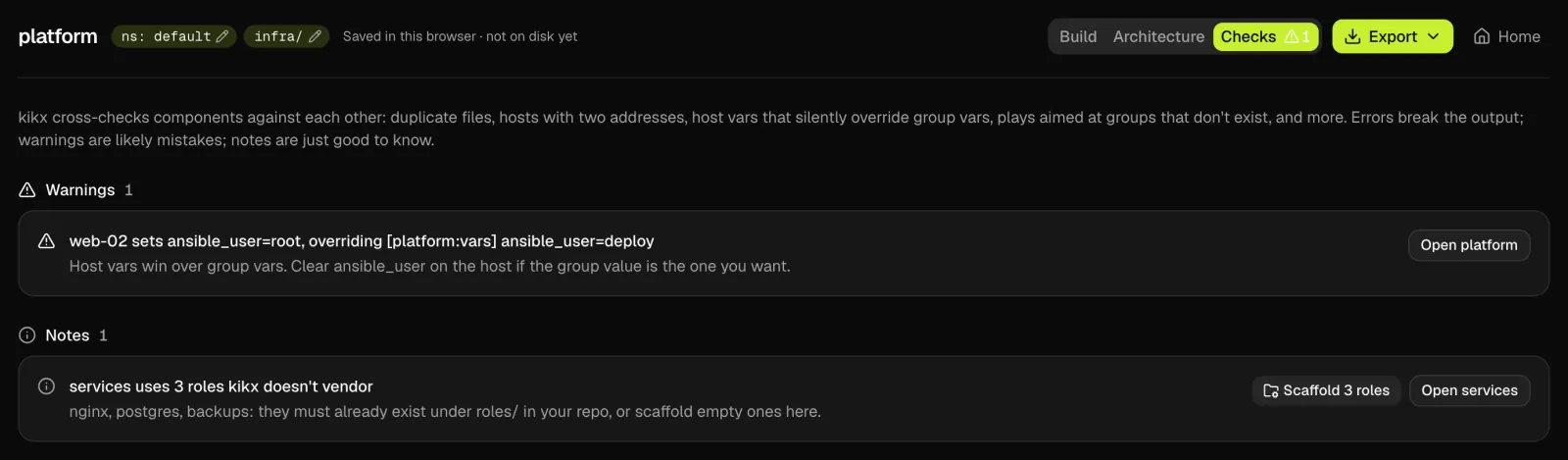
override
|
|
|---|
Severity |
warning
|
Trigger |
A host sets ansible_user or ansible_port to a non-empty value, and its group or an ancestor group sets the same key in vars to a different value |
Title |
<host> sets <key>=<host value>, overriding [<group>:vars] <key>=<group value>
|
Detail |
Host vars win over group vars. Clear <key> on the host if the group value is the one you want.
|
shared-addr
|
|
|---|
Severity |
warning
|
Trigger |
Two or more different host names have the same normalised address, in one or several inventories. One issue per address |
Title |
<count> hosts share the address <address>: <hosts>
|
Detail |
Different host names pointing at one machine run the same plays on it twice. Give each host its own address, or keep a single host.
|
range-overlap
|
|
|---|
Severity |
warning
|
Trigger |
Range fields of two different components overlap, that is one range contains the first address of the other. One issue per pair of fields |
Title |
<first name> (<first range>) and <second name> (<second range>) use overlapping networks
|
Detail |
Overlapping private networks cannot be peered or routed to each other. Fine if they never need to talk; otherwise pick ranges that do not overlap.
|
gv-layouts
|
|
|---|
Severity |
warning
|
Trigger |
Two or more ansible/group-vars components target the same group, whatever their layout |
Title |
Group "<group>" has both group_vars/<group>.yml and group_vars/<group>/main.yml
|
Detail |
Ansible loads and merges both, so a key set twice depends on load order. Keep one layout.
|
gv-group
|
|
|---|
Severity |
warning
|
Trigger |
A group-vars component’s group is not a known group |
Title |
group_vars/<group>.yml targets a group no inventory defines
|
Detail |
Those variables will never be loaded. Check the spelling against your inventory groups.
|
gv-shadow
|
|
|---|
Severity |
warning
|
Trigger |
A key is set both in a group-vars component and in the same group’s vars in an inventory, unless the group-vars value is present and equal to the inventory value |
Title |
<key> is set in both [<group>:vars] and group_vars/<group>.yml
|
Detail |
group_vars/<group>.yml wins (<file value> over <inventory value>). Keep it in one place. The part in parentheses is omitted when the key has no value in yaml
|
Group-vars keys are read from yaml when set, as top-level lines matching name: value with surrounding quotes removed from the value; otherwise from vars.
play-hosts
|
|
|---|
Severity |
warning
|
Trigger |
A play target is neither a known group nor an addressed host |
Title |
Play "<play name>" targets "<target>", which isn't in the inventory
|
Detail |
The play will match no hosts and silently do nothing.
|
site-missing
|
|
|---|
Severity |
warning
|
Trigger |
A site component imports a path that is not the playbook path of any playbook component |
Title |
<site name>.yml imports <path>, which this project doesn't produce
|
Detail |
Fine if the file already exists in your repo; otherwise add that playbook.
|
svc-selector
|
|
|---|
Severity |
warning
|
Trigger |
A service’s selector, app: <its app label>, matches the pod labels, app: <name>, of no k8s/deployment component |
Title |
Service <name> selects <selector>, but no deployment's pods carry those labels
|
Detail |
Its endpoints will be empty. Pods carry app=<deployment name>: name the deployment the same, or set the Service's app label to the deployment name.
|
ing-backend
|
|
|---|
Severity |
warning
|
Trigger |
An ingress’s service field, else its name, is not the name of any k8s/service component |
Title |
Ingress <name> routes to service "<service>", which isn't in the project
|
Detail |
none |
multi-inventory
|
|
|---|
Severity |
info
|
Trigger |
The project has more than one ansible/inventory component |
Title |
<count> inventories in this project
|
Detail |
Fine for separate environments; pass the right one with -i. Checks treat their groups as one pool.
|
ext-roles
|
|
|---|
Severity |
info
|
Trigger |
A playbook’s plays use roles that are not vendored roles |
Title |
<playbook name> uses <count> role kikx doesn't vendor, with roles when count is not 1
|
Detail |
<roles>: they must already exist under roles/ in your repo, or scaffold empty ones here.
|
Action |
scaffold-roles with the list of roles
|
not-imported
|
|
|---|
Severity |
info
|
Trigger |
The project has at least one site component, and a playbook’s path is imported by none of them |
Title |
<path> isn't imported by any site playbook
|
Detail |
It only runs if you call it directly.
|